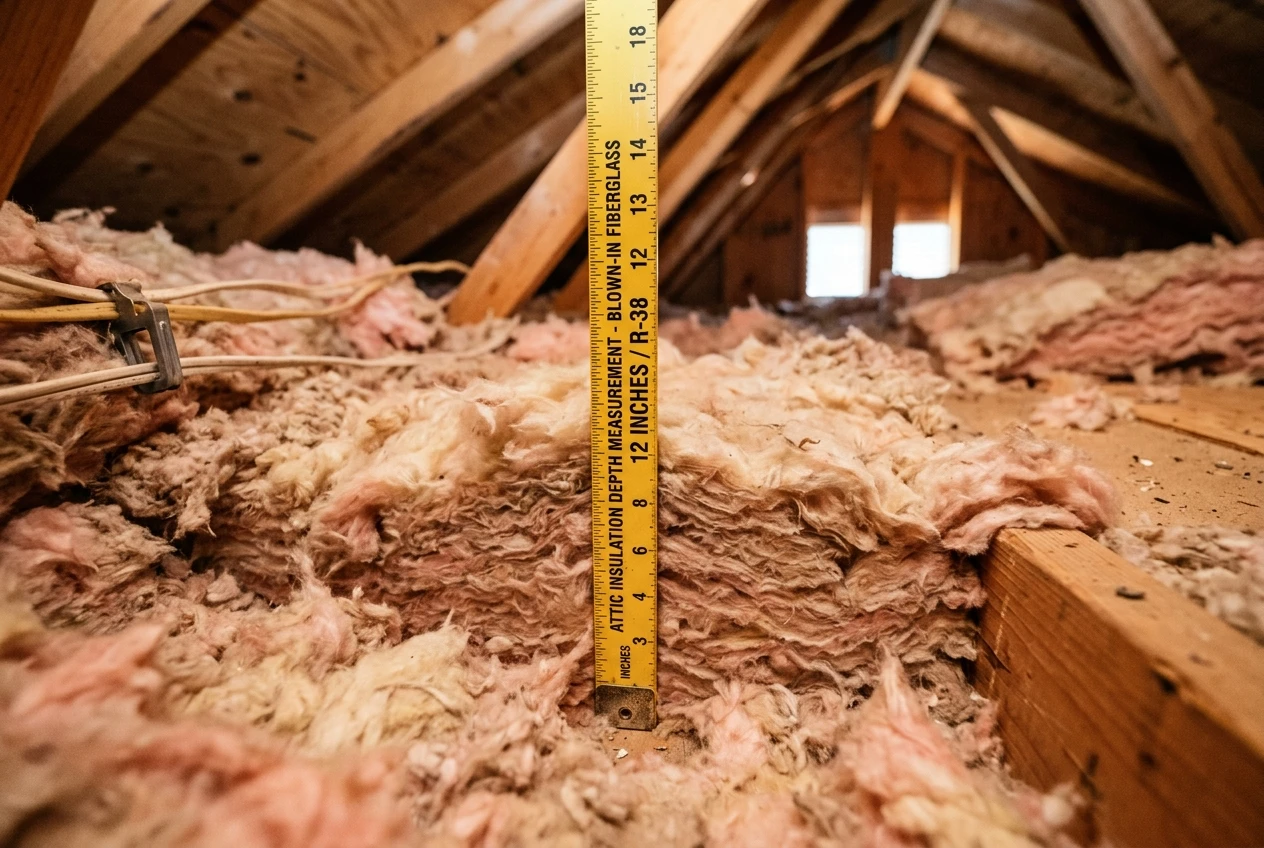
Houston attics need a minimum of R-38 to R-49, based on DOE guidelines for IECC Climate Zone 2A (hot-humid). Most homes built before 2000 have R-11 to R-19 - less than half the current recommendation. The 2021 International Energy Conservation Code, now adopted by most Texas cities, raised the prescriptive minimum from R-38 to R-49. Below either threshold, your AC works harder than it should, and the extra runtime shows up on your energy bill every month.
What Is an R-Value?
R-value measures how well a material resists heat flow. A higher number means more resistance - and more resistance means your attic keeps Houston's summer heat from flowing down into your living space. The "R" stands for thermal resistance, and values are additive: 3 inches of blown-in insulation at R-3.2 per inch adds up to roughly R-9.6.
Every inch of insulation you add costs money upfront. Every inch you are short costs money every month in extra cooling bills until it gets fixed.
Why Houston's Climate Zone Changes the Calculation
Houston sits in IECC Climate Zone 2A - hot and humid. In cold climates, attic insulation keeps heat inside the home in winter. In Houston, the primary job is the opposite: keeping heat out all summer long.
Your attic air temperature on a July afternoon can reach 140°F to 160°F. That heat radiates down through your ceiling into the living space, forcing your AC to run longer. Without adequate insulation, you are essentially heating your home from above through June, July, August, and September.
The Department of Energy sets R-value recommendations zone by zone for exactly this reason. Zone 2A calls for higher R-values than many cooler zones - not because the winters are harsh, but because the summers are intense and the cooling season runs nine months out of the year.
Recommended R-Values for Houston Attics
Here is how each R-value level translates to real conditions in a Houston attic:
| R-Value | Code Status | What It Means for Your Home |
|---|---|---|
| Below R-19 | Critically under-insulated | Pre-1980 standard; high AC bills, hot upper floors, HVAC running all night |
| R-19 to R-30 | Under-insulated | Common in 1990s homes; noticeably short of modern recommendations |
| R-38 | DOE minimum (older standard) | Baseline that older codes required; adequate but not optimal for Zone 2A |
| R-49 | 2021 IECC minimum | Current code standard for Texas; best balance of cost and performance |
| R-60 | Maximum benefit | Best for homes with ductwork in the attic, or when air sealing is done at the same time |
Source: DOE Energy Saver guidelines and 2021 International Energy Conservation Code (IECC) for Climate Zone 2.
How Many Inches Is R-49? Depth by Material
The R-value label tells you the performance goal. The inches tell you whether your attic has enough room. Here is what each R-value target requires by material:
| Material | To Reach R-38 | To Reach R-49 |
|---|---|---|
| Blown-In Insulation | 12-14 inches | 16-18 inches |
| Blown-In Cellulose | 10-12 inches | 13-15 inches |
| Open-Cell Spray Foam | 10-12 inches | 13-15 inches |
| Closed-Cell Spray Foam | 6-7 inches | 8-9 inches |
Blown-in insulation is the most common upgrade choice in Houston because of its cost per R-value gained. If your attic currently has 4 to 6 inches of settled blown-in (roughly R-13 to R-19), reaching R-49 means adding 10 to 14 more inches on top of what is there - assuming the existing material is dry and undamaged.
Spray foam makes more sense when your HVAC equipment or ductwork sits inside the attic space. Enclosing those components in the conditioned envelope with closed-cell spray foam on the roof deck dramatically improves system efficiency and reduces humidity problems.
How to Check Your Current R-Value
You do not need a contractor to get a rough number. Five steps:
- Open your attic access hatch. Most Houston homes have a pull-down stair or a ceiling hatch in a closet or hallway.
- Look at the insulation depth. If you can clearly see the tops of your ceiling joists (the wood framing), you are likely at R-19 or below. If the insulation sits well above the joists, you are in better shape.
- Identify the material. Loose gray or white fluffy material is blown-in insulation. Pink or yellow rectangular pieces are batt insulation. Gray, fibrous, paper-like material is cellulose.
- Measure the depth with a ruler. For blown-in insulation, each inch is roughly R-3.2. So 6 inches is about R-19. For batts, check the label on the facing - it will state R-13, R-19, R-30, etc.
- Look for warning signs. Dark streaks on batt edges mean air is flowing through the insulation, bypassing it. Uneven depth means material has shifted. Any moisture staining or discoloration means something beyond R-value needs attention.
What a ruler will not catch: air leaks at recessed lights, gaps at the attic hatch, compressed insulation at knee walls, or damage hidden under a surface layer. These failures lower your effective R-value without showing up in a depth measurement. A free inspection catches what the tape measure misses.
Why Your Attic May Not Perform at Its Stated R-Value
Adding inches is only part of the job. Several things reduce the effective R-value below what the depth measurement suggests:
- Compression. Insulation that gets walked on or packed loses R-value. Settled blown-in can lose 15 to 25 percent of its performance over time.
- Air bypasses. Recessed lights, attic hatches, plumbing penetrations, and open top plates are gaps where 140-degree attic air flows directly into your conditioned space - bypassing the insulation entirely. Air sealing before adding depth is the reason the DOE describes the two as a system, not separate jobs.
- Moisture damage. Insulation loses most of its R-value when wet. A roof leak or condensation problem that reached your insulation means the material is not performing - even if it looks intact from the hatch.
- Thermal bridging at joists. Ceiling joists have no insulation directly over them in older attics. They conduct heat from the attic to the room below at a fraction of the surrounding material's R-value.
This is why a measured depth reading is a starting point, not a final answer. A home with 6 inches of blown-in but 30 unblocked recessed lights has a whole-assembly R-value considerably lower than the depth alone would suggest.
What It Costs to Bring a Houston Attic to R-49
For a typical 1,800 sq ft Houston attic currently at R-19 to R-25, here are realistic installed cost ranges:
| Work Item | Typical Range |
|---|---|
| Blown-in insulation to R-49 (1,800 sq ft attic) | $1,800 - $3,500 |
| Open-cell spray foam to R-49 (1,800 sq ft attic) | $2,500 - $4,500 |
| Old insulation removal (if damaged or contaminated) | Add $1,000 - $2,500 |
| Air sealing (ceiling penetrations, recessed lights, hatch) | Add $500 - $1,500 |
Prices above are for materials and labor. Actual cost depends on your attic's square footage, current insulation depth, and whether removal or air sealing is needed first. Your written quote will itemize each line before any work is scheduled.
We serve homeowners throughout Greater Houston. If you are in Spring, Conroe, Kingwood, The Woodlands, Humble, Cypress, or Tomball, your free attic inspection includes a depth measurement, air leak check, and a written cost breakdown - before any work begins.
Find Out Your Attic's R-Value for Free
We inspect the attic, measure the depth, check for air leaks, and hand you a written quote. No pressure. No obligation.
Frequently Asked Questions
Serving Greater Houston Homeowners
Need your attic inspected and measured by a professional? We provide free walkthroughs across Tomball, Spring, Conroe, The Woodlands, Humble, and Kingwood.
Schedule Your Free Inspection →